
Lectures
It's hard to talk about computer or Internet security these days without mentioning cryptography. By separating the security of information from the security of the media over which it is transmitted and stored, cryptographic techniques seem ideal for protecting data on widely decentralized networks like the Internet and stored in files on insecure PCs and workstations. That's the theory, anyway. In practice, cryptography is almost never available where it would be most useful. While some of the reasons for this are political (out-of-touch standards bodies and cold war-era export controls discourage vendors from including cryptography as a basic feature), there are also very difficult technical and engineering barriers to using cryptography on a large scale. This talk will focus on some of the technical problems in integrating secure cryptography into real applications, operating systems, and networks.
Matt Blaze is a Principal Research Scientist at AT&T Laboratories, where he studies computer security, applied cryptology, and large scale distributed computing sytstems. His recent work has been influential in shaping the technological aspects of US cryptography policy; his 1994 discovery of a fundamental weakness in the US Government's proposed ``Clipper'' key escrow system was a turning point in the cryptography debate and has sparked an ongoing area of cryptology research. His current interests focus on the use of secure hardware, the management and specification of trust in large systems, public-key certificate infrastructure, and cryptography policy. Matt holds a PhD in Computer Science from Princeton University. He received the Electronic Frontier Foundation's Pioneer award in 1996.
Matt Blaze is coming thanks to the the support of the USENIX Association.

Kim Biel-Nielsen, EurOpen / UNIWARE
The network computer
Since its emergence more than 10 years ago the PC has had an incredible success. Never before in the history of IT has so much computing power at such low prices been put in the hands of millions of users. The PC has been the embodiment of the dream of control in the hands of the users - and indeed never before have the users been given so many good tools and choices between solutions.
The downside however has been an ever increasing reliance on a single company - Microsoft, and an ever increasing nightmare of updating, managing and bug avoidance in a very unintuitive environment - The IBM PC architecture.
Today the cost of ownership of even a few networked PCs way surpass the actual investment in hardware and software. The success of the Internet brings a new solution - the Network Computer or the NC - a simple yet immensely powerful device which combines the potential for ease of use with all the benefits of a zero administration client and the vast amount of information and solutions on the Internet.
In his presentation Kim Biel-Nielsen will focus on the NC its benefits and strengths and where it successfully can be deployed as an alternative to traditional PCs.
Kim Biel-Nielsen is EurOpen Chairman/president and founder of UNIWARE danmark aps
kbn@dk.net
Peter Karlsson, Sun Microsystems
Java: The Next Wave of Computing
The popularity of Java continues to grow at amazing speed around the world. Here's why.
William Bello, Bello Ltd
Virtual LAN in practice (45 min)
As a part of emerging LAN switching technology, Virtual LANs are one of most promising and intriguing concepts yet very unknown in practice. For modern workgroup oriented managers that seek for efficiency it is very easy to accept business driven LAN configuration that will put together in one broadcast domain users belonging to the same workgroup regardless of their physical location. Recently the first practical deployment of VLAN technology has been done on project connecting dozen remote locations over public frame relay network and configuring LANs according to business processes needs, not physical layout.
William Bello, born 1957, graduated 1982 at Zagreb, University as Applied Mathematics Engineer, MIS consultant and director for INA-OKI and PLIVA. Since 1993 owner and founder of BELLO Ltd., consultant and project company specialized in data communication with operations in Croatia, Slovenia, Bosnia, Hungary and Albania.
William Bello (Bello Ltd, Croatia)
wbello@open.cc.etf.hr
Isabelle Gayral, EMDT
WWW-Intranet/Internet
The growing importance of the web. The web as a real and complete information system (Internal and External). SGI tools like Cosmo, web serving. Security. Applications. Example of benefits and use: BMW, Chrysler, SGI, American On line, Universities etc..
Isabelle Gayral Boschung,
Business Development Manager
European & Midle East Distribution Territory
E-mail: isabelle@gland.sgi.com
Tel: 00 41 22 999 96 00,
Fax: 00 41 22 999 96 01
Michael Schlenhrich, SGI
High performance Computing
What is the real high performance computing. The different technologies (including SGI and Cray). Performance and constraints. High computing & Complex data visualisation. Virtual Reality. Applications: in which areas the hpc is more and more used. Concrete examples.

Zbig Zdanowicz,
Regional Manager, SCO Eastern Europe & Central Asia
The Future of UNIX
SCO has a unique perspective on the future of for UNIX, as the owners of the original System V source technology, the co-developers of the next generation 64-bit UNIX with HP, and as the largest shipper of UNIX server operating systems.
This presentation charts SCO's view of the future for the UNIX industry as a whole, not just for SCO's products, and analyses the change from Host-based computing, through client/server computing, to the Internet Way of Computing.
Mark Cotton,
Clustering Architect, SCO European Development Centre
Clustering Intel UNIX systems
SCO is the first UNIX vendor to provide a UNIX clustering solution for Intel UNIX, allowing clusters to be built from industry standard PCs. This presentation is a technical view of the solution, and looks at the benefits and practicalities of a Clustered Intel UNIX system.
(name to be confirmed), SCO
FREE SCO OpenServer
A review of FREE SCO OpenServer - what it is, why you should be interested, who's using it, and how popular has it been ?

Mario Kovac, FER - Zagreb
Multimedia data compression
The presentation will address problems related to multimedia and data usage in the open systems environment. Several data compression techniques, including JPEG and MPEG, will be presented as a widely accepted solutions for the above problem. HW/SW compression/decompression approaches will be compared.
kovac@rasip.fer.hr
Kristijan Zimmer, HrOpen - Croatia
Web multimedia over standard dial-up lines
The lecture covers examples of Web interfaces with cameras and robots,
examples of successful multimedia products and solutions used on standard dial-up lines,
basics of the RTSP (Real Time Streaming Protocol) and integration of multimedia
elements on the Web pages.
kristijan.zimmer@open.hr
Kristijan Zimmer is the HrOpen's secretary. His work so far included several projects covering Web interfaces with on-line measurement instruments, multimedia on the WWW, Web design and business usage of Internet-based technologies.
Igor Sunday Pandzic, MiraLab - Switzerland
Synthetic/Natural Hybrid Coding in MPEG-4
MPEG-1 and MPEG-2 are widely used standards for compression of audio-visual data. MPEG-4 is scheduled to become an International Standard in November 1998 and the group is working hard towards that goal. In a world where audio-visual data is increasingly stored, transferred and manipulated digitally, MPEG-4 sets its objectives beyond "plain" compression. Instead of regarding video as a sequence of frames with fixed shape and size and with attached audio information, the video scene is regarded as a set of dynamic objects. Thus the background of the scene might be one object, a moving car another, the sound of the engine the third etc. The objects are spatially and temporally independent and therefore can be stored, transferred and manipulated independently. The composition of the final scene is done at the decoder, potentially allowing great manipulation freedom to the consumer of the data.
Video and audio acquired by recording from the real world is called natural. In addition to the natural objects, MPEG-4 aims to enable integration of synthetic objects within the scene. Synthetic, computer generated graphics and sounds are being produced and used in ever increasing quantities, however they are mostly rendered onto classical video/audio storage media and used as such. This represents a loss of information about the original synthetic objects and reduces the possibility of their manipulation and reusing.
MPEG-4 proposes to code the synthetic objects (3d objects, 2D objects, synthetic audio) in their original form and perform the rendering and composition of the scene at the decoder, i.e. at the time of consuming the information. This is the role of the Synthetic/Natural Hybrid Coding (SNHC) group of MPEG. In view of complexity of the task, SNHC has adopted a bottom-up approach, concentrating in the beginning on particular application fields and defining future extensions that will take place as the work proceeds. In its ultimate goal, SNHC aims to provide a framework for applications integrating dynamic 3D and 2D objects, 3D synthetic sound, virtual human representations, natural sound and video, data coming from local storage or streamed through the network, each object being independant and open to manipulation. These might be the Networked Collaborative Virtual Environments allowing multi user applications such as virtual teleconferencing, collaborative 3D design, games, teleshopping, medical applications, distance learning/training etc.
In the current stage, the most important efforts in SNHC are directed towards face and body animation, media integration of text and graphics, text to speech synthesis (TTS) and musical sound synthesis. We will look in particular at the Face and body animation group. This group deals with coding of human faces and bodies, i.e. efficient representation of their shape and movement. This is important for a number of applications ranging from communication, entertainment to ergonomics and medicine. Therefore there exists quite a strong interest for standardisation. The SNHC group has issued a draft document defining in detail the parameters for both definition and animation of human faces and bodies. This draft is based on proposals from several leading institutions in the field of virtual humans research. Currently the work is going towards implementation of a Verification Model, i.e. a working software model that can be used for experiments. Based on the experiment results the current draft will be updated, then integrated with the work of other groups and step by step a new standard will emerge.
Authors: Igor S. Pandzic & alt.
E-mail:Igor.Pandzic@cui.unige.ch

Keld Simonsen, keld@dkuug.dk
Internationalization standards and software
Keld will describe the international and European standards on internationalization and cultural software support, most originating from UNIX/POSIX systems. He will also then describe some freely available software and data for internationalization.
Jean-Michel Cornu, EurOpen
The ICT partnership: Cooperation through Europe
More then 50 European Associations in Information and Communication Technology, have decided to cooperate with each other and with the European Commission.
Smaller associations can also participate through electronic services. This is a way to access to information at the European level,
and to become active through ICT Round Tables and through European projects.
And also:
Possibility to organise a BOF with persons interested in Participating to European projects (How to proceed, Where to find Information)
Jean-Michel.Cornu@afuu.fr
Domagoj Vucica Pulsar, Split
Silvana Tomic ZIH, Zagreb
Software preocess improvement - hypothesis for information society establishment
The reasons of software development being a bottle-neck of informatization. The role of software in information society. Experiences in software process improvement (Esprit Bootstrap, ISO 9001 and 9000-3). The future trends evaluation and their influence upon software industry (Esprit 4, Spice, ISO 15504).
silvana.tomic@open.hr
Zoran Bekic, Miroslav Milinovic
From Beginners To Advanced Users
A range of educational activities are required to enable users. They should be complemented with intensive and extensive publication activities and dedicated events. All types of users require continuous helpdesk/hotline services.
Jasenka Gojsic, Anica Juretic, Zoran Vlah
Getting Technology To Users And Real Life
Procurement and deployment of hardware, software, applications and solutions for the whole academic community is the key for fast, concentrated penetration of new information technologies to developing segments of society. The way to do it is through carefully selected pilot projects performed in cooperation of academic and target communities.

Ruzica Vucic, Jasenka Gojsic
Applications of Broadband Digital Networks
Video and audio broadcasting and conferencing, disk
sharing in WAN environment, computer-telephony
integration.
Pilot projects and technology transfer.
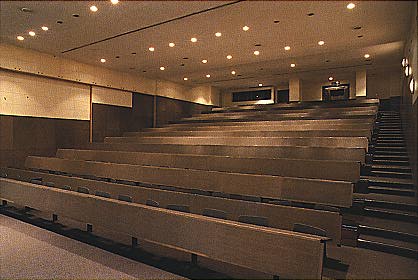
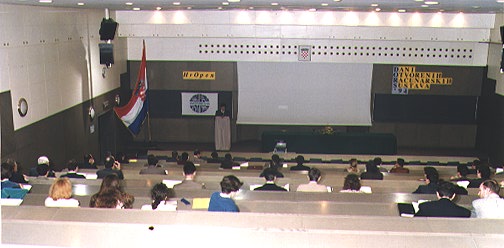
Congress Hall during HrOpen's Open Computing Days 1994.