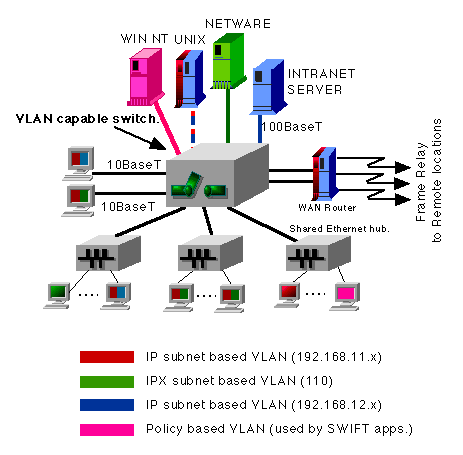
This is a central site local network of a large bank. Technology used is Ethernet (10 Mbps and 100 Mbps) but customer is aware of the future need for higher speeds and is therefor using switching architecture which will enable easy migration to ATM. Network has over 250 PC workstations, 2 Unix servers for database transactions and a 2 Novell Netware servers (only one of them is shown in the picture).
Network is divided into three VLANs based on network layer subnets.
Red VLAN is for financial transactions between remote locations and central site.
Blue VLAN is used for stations who need access to the Intranet server used for intranet e-mail and web pages.
Green VLAN is based on IPX subnet and is used for Novell Netware File Server users.
Pink VLAN is a policy based VLAN for users of SWIFT applications.
Enduser stations are physically separated into collision domain with 10BaseT Ethernet hubs which are connected to switched ports of the LAN switch. Servers are connected to the 100BaseT ports on the switch for higher throughput.
This kind of VLAN organization ensures that broadcasts are constrained to VLAN members only. Since IPX is used heavily on the network, there are a lot of broadcast updates between the servers. Also RIP is used as a routing protocol on the WAN and also generates a lot of broadcast .
Through the use of VLANs, automatic moves, adds and changes are enabled in the network since the switches themselves put workstations in corresponding VLANs based on their IP and IPX subnets.
In the future migration to ATM network, VLANs will be mapped directly to the ATM's Emulated LANs (ELAN) through the use of LAN Emulation standard (LANE) which is supported in the switch. This will enable a very efficient migration to ATM without the need to redesign the network.