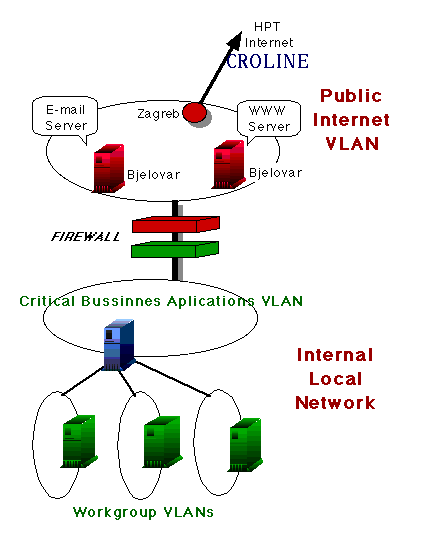
While VLANs are essentially broadcast domains, they do have other added advantages which make them more powerful and advantageous than traditional hub/router broadcast domains. These benefits help make VLANs more powerful than traditional broadcast domains while also making a network managerís life a lot easier.
Theoretically, IP network addresses can be assigned any way an administrator chooses. Unfortunately that's not true in practice for most networks today. The reason is the Internet. In order to mesh a private network with the Internet, most organizations use network numbers assigned by the Internet Number Authority. The explosive growth of the Internet has quickly used up a large percentage of the possible network numbers and the numbers available to organizations has become very limited (unless they decide to use the IP addresses out of the private address space in combination with network address translation). Routers do not help administrators conserve subnet numbers since each port on a router is generally its own subnet.
Virtual LANs reduce the waste of scarce IP addresses by using a limited number of network addresses very efficiently. In a hub/router-based network, each LAN segment usually needs its own subnet number so that routers can move data between subnets. This quickly becomes inefficient unless there are enough users on a single router port to fill-in all of the possible IP addresses. Using variable length subnet masks helps to presere the IP address space to a certain extent in hub/router-based networks. In a network based on virtual LANs, any number of LAN segments can be combined into a single virtual LAN, allowing administrators to assign IP addresses and subnets more efficiently. A subnet can be one port on one switch, multiple ports on one switch, or multiple ports on multiple switches.
Virtual LANs offer better network security. Consider a network built with hubs. Anyone can plug a protocol analyzer (or a PC with protocol analyzer software) into any connection on a hub and intercept all of the data that is being sent on that segment. The data being intercepted could easily be confidential.
If each device is connected to its own port on a network with switched VLANs, then that's not possible. The only observable information is intended for the device attached to that port. With Policy Based VLANs MAC and IP addresses can be bound to a port -- ensuring that only users with a specific MAC and IP address can operate on a switch port adding to a user's security.