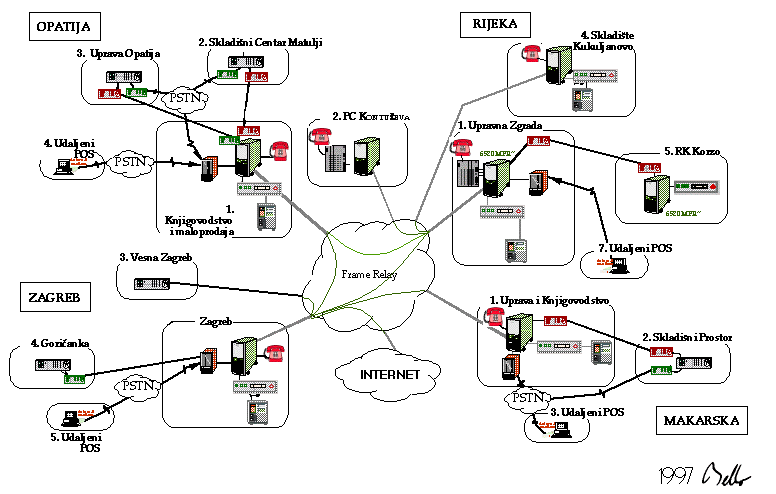
Shown in the picture is a LAN and WAN of a large Croatian holding company with locations in all the major cities in Croatia and a lot of remote sites.
In the central locations, LAN switching is used to provide users on a local network with high bandwidth and to enable the use of VLAN technology. Sites are connected to remote locations through Frame Relay network using Frame Relay switches with routing capabilities on central locations and branch office routers (Frame Relay Access Device - FRAD) on remote locations.
The network is dominantly using IP as a base Layer 3 network protocol and static routing and RIP as a routing protocol.
Voice Relay (Voice over Frame Relay) technology is used for voice communications between central sites which cuts down on telecommunication costs significantly since both data traffic and voice traffic use the same private network infrastructure.
VLAN technology enables a logical division of a network into groups based on company policies and processes and not on physical location. Thus, the financial department, using Oracle Financials, is put into a separate VLAN which exists on all locations throughout the entire network. Every user in this VLAN has the same network resources and availability as any other in the same VLAN. It is not possible to achieve this using ordinary router-hub model of networking.
Other VLANs include: a default "dirty" VLAN for general operations, an Internet VLAN for Internet servers, an intranet VLAN for internal WWW and e-mail operations and a Sales Support Applications VLAN.
Although this is a switched network in the centers, RIP is still used in the WAN and is producing broadcasts, VLANs are used to shield the users from unnecessary broadcasts by putting routers only into those VLANs that need access to remote sites.