
 |
|
 |
 |
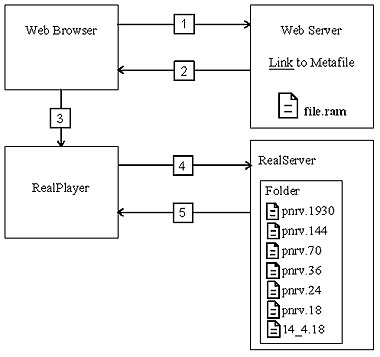
Primarily interesting for Intranet use is the support for the IP Multicast, which can be a great bandwidth saver, if many users experience the same media streams at the same time. IP Multicast allow multiple clients to share a single stream form a server. Today is multicasting with certain exceptions, only possible in the Intranet environments, because few Internet routers are configured to support multicast data. On the Internet, splitters provide similar benefits.
HTTP pseudo streaming, integrated in the Encoders, make possible for the ISPs to put Real Audio/Video files on the HTTP server, similarly to the technique seen at Vivo.
Buffered play is used for viewing the material that needs higher bandwidths then those between server and client. The streaming media is not shown before it is downloaded to the client. This looks like the technology described under B), and we can conclude that some tricks are used from the time before the boom of streaming multimedia, sort of historically backward compatibility is used.
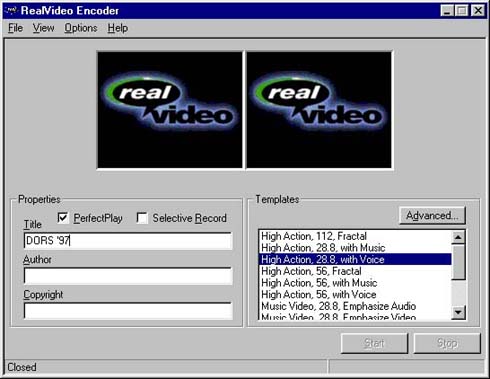
RealVideo encoders offer wide arrange of media bandwidths (from 14.4 kbps to ...), as well as different compression techniques. Servers can serve on-demand and live video The developers were concentrated to optimize video on two prevalent Internet connection speeds of 28.8 kbps and 56 kbps.
Interactivity is achieved through features such as clickable video maps, synchronized multimedia and scriptable plug-ins.
Bandwidth negotiations and dynamic connection management help assure that video is delivered in the best way under existing conditions.
RealVideo provides two codecs - RealVideo Standard (developed by Progressive Networks), and Clear Video's RealVideo Fractal. The Standard compression is recommended for low bandwidth and Internet usage, the encoding is faster, and live encoding possible. Fractal codec produces better decoding performance.
The RealPlayer supports both UDP and TCP based protocol. The TCP is best in fast Intranet environments, but UDP's efficiency is required to avoid pauses in delivery. The Player intelligently selects better solution.
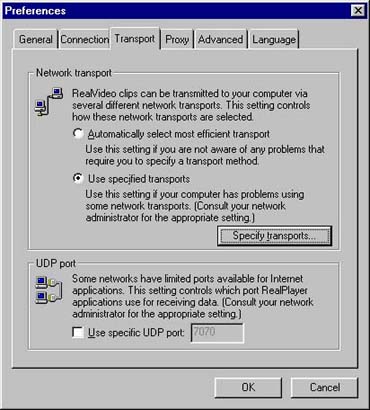
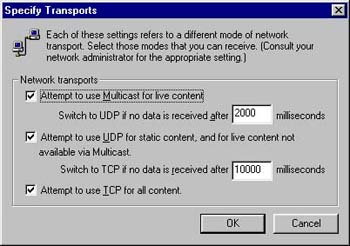
RealVideo Player transport options
Unlike audio, packet losses to a video stream can cause errors in the image that are persistent over many frames. So called Robust UDP is used to reduce typical Internet packet losses to a level that can be handled by error mitigation. To minimize the problems caused by lost packets, two methods are introduced:
| RealVideo for low bandwidths - l | RealVideo for high bandwidths - l |
| RealVideo for low bandwidths - n | RealVideo for high bandwidths - n |