 |
|
 |
 |
The concept of the Virtual Reality Modeling Language is to set rules for creation of three dimensional virtual environment, which can be experienced by users in an interactive way. Although VRML is a standardized form of such environment, there are many custom versions around. Some of them introduce features still unsupported by the official standard, and help speed up the development of the algorithms and techniques.
VRML 1.0 specification had several limitations and some features were hard to implement by both software and hardware. VRML 2.0 not only fixed several problems but also added features such as behavior scripting and 3D sound.
The VRML files describe the elements of the 3D worlds by position, shape, material, position of light and audio sources in space etc.
For many popular 3D development tools such as 3D Studio and AutoCAD there are converters to VRML standard. There are also many authoring tools available. But no matter which one is chosen, advises such as to carefully plan the elements in the world, to stick with the real-world examples, to keep scenes simples as well as object textures, always apply.
There are many VRML viewers which differ in the speed, capabilities, texturing algorithms, and navigation. Live3D is one of the fastest, and comes as a plug-in for Netscape. SGI's WebSpace incorporates most possibilities and can be understood as technology leader. Other viewers include CyberGate, VRweb, WIRL, VR Scout, Liquid Reality, CyberPassage, TerraForm, Microsoft's VRML Add-In for Internet Explorer etc.
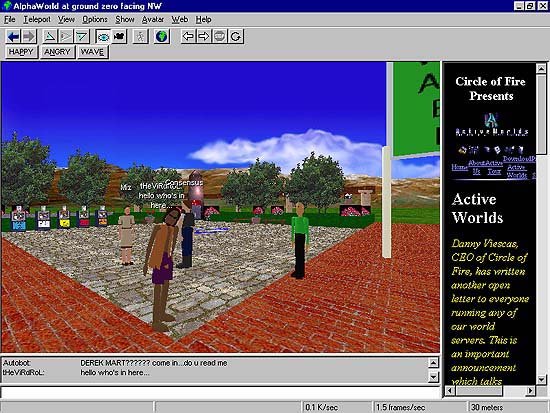
One of non-standard 3D environment was initiated by a firm called World Inc. After checking in, visitors can download their custom free viewer, and experience joy of walking through beautiful scenery, meet other people, dance Macarena with them and building their own houses, sculptures and other objects. Croatia has it's own quarter in the biggest of all worlds there called the AlphaWorld. AlphaWorld is pretty much what VRML should become in the future.